Choosing mobile loading arms for logistics in 2026 requires more than comparing prices and flow rates. Warehouses now handle tighter schedules, varied vehicle sizes, and stronger expectations for safety. A suitable loading arm should support controlled transfer, reduce operator strain, and move smoothly across changing loading points. In daily operations, small details matter. Swivel joints should resist stiffness. Hoses need practical reach. Emergency shutoff access must remain clear.
Why do mobile loading arms offer flexibility in logistics? Their adjustable position allows one unit to serve several bays, tankers, or packaged-liquid handling areas. This can reduce fixed installation requirements and help facilities respond to seasonal demand. However, mobility is not automatically an advantage. A poorly balanced arm may be difficult to position, especially on uneven floors. Wheels, brakes, grounding provisions, and connection compatibility deserve careful inspection.
Experienced buyers should assess product records, maintenance support, operator feedback, and documented testing. Ask how the arm performs after repeated movement, not only during a factory demonstration. Check temperature ranges, material compatibility, cleaning needs, and recommended inspection intervals. Stainless steel may suit demanding environments, but material selection still depends on the handled product and site conditions.
The best choice is rarely the most impressive model. It is the arm that fits actual workflows. Measure the loading area. Observe operators. Record transfer times and awkward movements. Some assumptions may prove wrong. A practical trial can reveal problems that specifications hide. In 2026, reliable logistics equipment should combine flexibility, safe design, durable construction, and evidence-based selection. That balance supports productivity without treating safety as an afterthought.
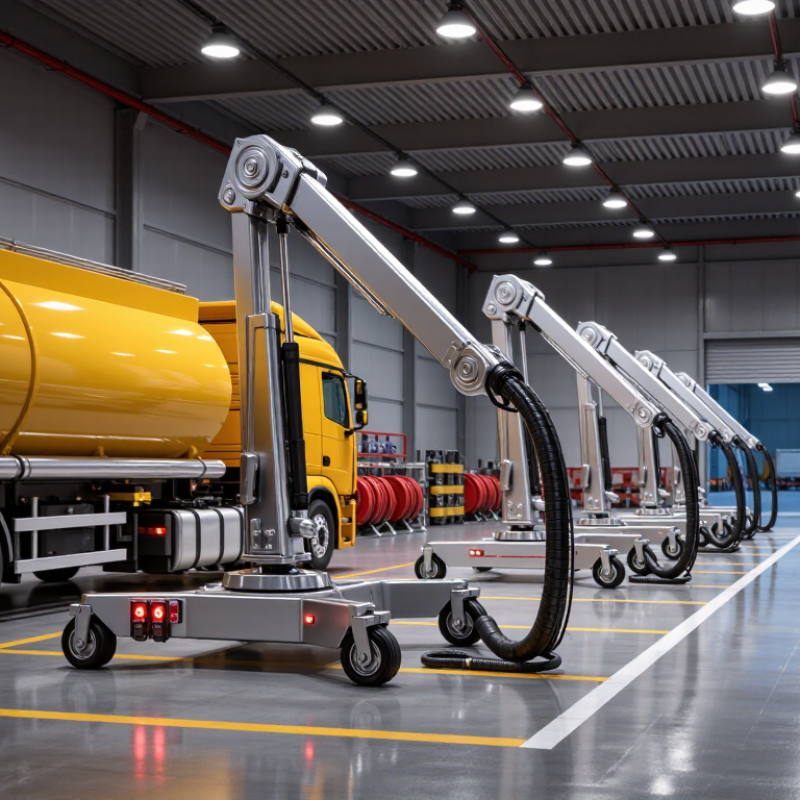
Choosing mobile loading arms in 2026 should begin with the loading task, not the equipment catalogue. UNCTAD’s Review of Maritime Transport 2024 reports that over 80% of global merchandise trade moves by sea. This scale increases pressure on terminals to load trucks, railcars, and barges quickly. Define the vehicle connection height, loading position, batch volume, target flow rate, working pressure, and transfer time. Include vapor recovery, grounding, emergency release, and hose-drainage needs. A practical site survey should measure the arm’s maximum reach, swivel clearance, and parked position beside a crowded bay.
Material characteristics determine the arm’s wetted construction and sealing system. Record viscosity, density, temperature, vapor pressure, corrosivity, solid content, and cleaning chemicals. A cold, thick liquid may need heat tracing or a larger passage. A volatile liquid may require closed coupling and vapor balancing. The International Energy Agency’s Oil 2024 report expects global oil demand to exceed 100 million barrels daily through 2030, highlighting the need for dependable, high-cycle transfer systems. However, that demand figure does not define your site conditions.
Do not select by flow rate alone. Pressure loss, surge behavior, and operator movement can change the real result. I have seen layouts that looked adequate on paper but forced operators to twist the arm sharply. That was a design weakness. Recheck it. Use recognized engineering standards, supplier test records, and material compatibility evidence before approval. Record every assumption, including seasonal temperature and future throughput. Some requirements will remain uncertain, and that uncertainty should be tested rather than hidden.
Mobile loading arms should match the transfer route, not just the product volume. UNCTAD’s Review of Maritime Transport 2024 states that ships carry over 80% of global merchandise trade by volume. The Energy Institute Statistical Review 2024 recorded global oil demand at about 101.7 million barrels per day in 2023. These figures underline a practical issue: loading points need flexible, repeatable connections.
Articulated arms suit frequent truck or rail movements. Their swivel joints provide a wider working envelope and reduce manual hose handling. Telescopic designs offer longer reach, but they need stronger support and careful balance. A mobile skid with bottom loading can shorten connection time. Top loading may fit older vehicles, though it can increase operator exposure and alignment problems.
Vapor-return lines, grounding checks, breakaway couplings, and clear emergency access should be part of the operating configuration. Flow rate matters, but recovery time matters too. A longer arm is not automatically better. I have seen compact layouts become inefficient because operators had to reposition the unit repeatedly. That design flaw is easy to miss on paper.
Tips: Measure the real bay geometry. Record vehicle heights, hose angles, turning space, and winter access. Compare normal and worst-case loading cycles. Verify swivel torque, drain points, inspection access, and maintenance intervals against applicable engineering standards. Leave room for human error. Perfect drawings rarely meet imperfect sites.
Choosing mobile loading arms in 2026 requires more than checking reach, capacity, and price. Safety begins with controlled movement. Look for breakaway couplings, emergency shutoff valves, grounding interlocks, and leak-resistant swivel joints. A clear bonding signal should prevent transfer when the vehicle is not properly grounded. Small gaps matter.
Compliance depends on location, product, and operating pressure. Specify equipment against applicable standards, such as IEC 60079 for explosive atmospheres, and maintain documented inspection records. Operators should verify pressure ratings, hose compatibility, vapor-return requirements, and emergency procedures before purchase. OSHA’s Process Safety Management framework also emphasizes written procedures, training, maintenance, and management of change. A technically strong arm can still fail an audit if records are weak.
Environmental protection deserves equal attention. The IEA’s Global Methane Tracker 2024 estimates that about 40% of fossil-fuel methane emissions could be reduced at no net cost. Vapor recovery connections, sealed couplings, drip trays, and automatic isolation can support that opportunity. For volatile liquids, specify emission-control performance instead of accepting vague “low-loss” claims. I would not assume every sensor remains accurate after rain, vibration, or repeated repositioning. Require calibration intervals and field-test results. The best choice is usually the arm that workers can inspect quickly, operate consistently, and shut down without hesitation.
How to Choose Mobile Loading Arms for Logistics in 2026?
Mobility should match the loading bay, not just the product brochure. Check reach, turning radius, wheel or rail movement, parking space, and locking points. A mobile arm must stay stable beside a tanker or railcar. It should also support the required flow rate without excessive hose stress. The World Bank’s 2023 Logistics Performance Index connects logistics quality with speed and reliability. Small positioning delays can therefore affect wider schedules.
Compatibility requires more than matching pipe size. Confirm fluid viscosity, temperature, pressure, vapor-control needs, seal materials, grounding, and connection standards. Review API and ISO guidance with qualified engineers. Maintenance planning matters too. Plant Engineering’s 2023 Maintenance Study reported that 82% of facilities experienced unplanned downtime within three years. Choose accessible swivels, replaceable seals, clear inspection points, and documented service intervals. A low purchase price can become expensive after repeated leaks, stoppages, or difficult inspections.
Tips: Build a five-year total-cost sheet. Include installation, training, inspections, spare seals, energy use, downtime, and eventual replacement. Test the arm with real bay dimensions before ordering. A perfect specification is rare. Operator judgment still matters, because spreadsheets may miss awkward hose angles or poor parking access. Review those assumptions openly.
Select the Best Loading Arm for 2026 Logistics Operations
Selecting a mobile loading arm requires more than checking reach and price. In 2026, operators need equipment that supports faster transfers, safer handling, and changing site layouts. UNCTAD’s Review of Maritime Transport 2024 highlights continuing pressure on global shipping capacity and port efficiency. Delays can quickly spread across warehouses, vehicles, and distribution schedules. A mobile arm with smooth movement, accurate positioning, and quick connection procedures can reduce avoidable waiting time.
Inspect the working environment carefully. Measure bay height, vehicle access, turning space, and the distance between storage points. Then match the arm’s load rating, reach, swivel range, and hose compatibility to real operating conditions. The World Bank’s Logistics Performance Index 2023 shows major differences in supply-chain speed between stronger and weaker logistics systems. Small handling delays matter. They accumulate.
Safety deserves practical attention. Choose systems with visible emergency shutoffs, stable brakes, controlled movement, and easy inspection points. Operators should not need awkward stretching to connect equipment. Training records and maintenance logs also support reliable operation. I would test the arm during the busiest shift, not only during a quiet demonstration. That exposes vibration, access problems, and slow repositioning. One weakness remains easy to miss: a highly flexible arm may require more frequent inspection. That trade-off needs honest review before purchase.
| Logistics Application | Typical Product or Service | Recommended Loading-Arm Configuration | Typical Flow-Rate Range | Typical Connection and Reach | Important Safety and Material Requirements | 2026 Selection Priority |
|---|---|---|---|---|---|---|
| Road tanker top loading | Gasoline, diesel, kerosene and other petroleum products | Top-loading arm with swivel joints, product shut-off valve and optional vapor-return line | Approximately 500–1,500 L/min, subject to product, pump capacity and site limits | Commonly 2–4 m horizontal operating reach; tanker connection is usually a bottom-entry or top-entry nozzle | Electrically continuous bonding, overfill protection, anti-static design, compatible seals and hazardous-area equipment where required | Prioritize safe vehicle positioning, vapor control and fast repeatable loading |
| Road tanker bottom loading | Fuel distribution and high-throughput liquid transfer | Bottom-loading arm with API-style coupler or locally specified dry-disconnect coupling and vapor-return connection | Approximately 800–2,500 L/min per loading point, depending on the terminal system | Normally 1.5–3 m operating envelope; coupling height must match the tanker manifold | Dry-break coupling, emergency breakaway protection, overfill sensors, grounding verification and pressure-rated components | Prioritize loading speed, spill prevention, coupler durability and fleet compatibility |
| Chemical liquid transfer | Solvents, acids, alkalis and specialty chemicals | Closed-transfer arm with chemical-resistant hose or pipe section, double isolation and drainable design | Approximately 100–800 L/min; corrosive or viscous products may require lower rates | Commonly 1.5–3 m reach; select connections according to the product’s chemical compatibility | Material selection must consider corrosion, permeation, temperature, pressure and cleaning method; provide containment for residual liquid | Prioritize chemical compatibility, closed handling and easy decontamination |
| Food and pharmaceutical logistics | Edible oils, syrups, liquid ingredients and hygienic process liquids | Sanitary loading arm with smooth internal surfaces, hygienic fittings and cleanable product path | Approximately 100–600 L/min, depending on viscosity and hygiene requirements | Usually 1.5–3 m reach; connection size is selected to limit pressure loss and cleaning time | Use product-compatible stainless-steel wetted parts, hygienic seals, drainability and documented cleaning procedures | Prioritize cleanability, traceability, contamination prevention and changeover time |
| High-viscosity liquid handling | Lubricants, heavy oils, resins and concentrated liquids | Large-bore arm with heated or insulated section where required, low-shear bends and positive-displacement pump support | Approximately 50–500 L/min; actual capacity is strongly affected by viscosity and temperature | Typically 1.5–3 m reach with a larger nominal diameter to reduce pressure loss | Check viscosity at minimum operating temperature, seal performance, heat-tracing controls and hose flexibility | Prioritize pressure loss, thermal control, draining and prevention of product solidification |
| LPG and liquefied gases | Liquefied petroleum gas and other liquefied gaseous products | Specialized pressure-rated loading arm with liquid and vapor lines, emergency shut-off and breakaway protection | Approximately 100–1,000 L/min, depending on product, pressure and terminal design | Reach commonly 1.5–3 m; connections must match the pressure vessel and approved transfer procedure | Pressure and temperature ratings, controlled venting, excess-flow protection, grounding and hazardous-area compliance are essential | Prioritize pressure integrity, emergency isolation, vapor management and operator protection |
| Cryogenic liquid transfer | Liquefied gases stored at cryogenic temperatures | Cryogenic loading arm or vacuum-insulated transfer assembly with purge and emergency release provisions | Approximately 100–1,500 L/min, depending on fluid, tank design and allowable pressure drop | Often 1.5–4 m reach; movement allowance must accommodate thermal contraction and vehicle positioning | Use materials and seals rated for cryogenic temperatures; provide frost protection, controlled venting and emergency isolation | Prioritize low-temperature performance, thermal movement, purge procedures and emergency release |
| Mobile or relocatable loading station | Temporary terminals, project logistics and seasonal distribution points | Compact articulated arm mounted on a skid, frame or mobile platform with quick-connect utilities | Approximately 100–1,000 L/min, selected according to the temporary pump and storage system | Typical reach of 1.5–3 m; minimize transport width and provide secure parking or anchoring points | Design for repeated assembly, lifting, weather exposure, hose protection, grounding and rapid inspection | Prioritize portability, setup time, structural stability and compatibility with multiple sites |
| Railcar loading and unloading | Bulk liquids moved between railcars and storage facilities | Long-reach articulated arm with access platform, swivel joints, emergency disconnect and optional vapor recovery | Approximately 500–2,000 L/min, depending on railcar fittings and transfer system | Often 3–6 m operating reach; movement must accommodate railcar height and track-side alignment variation | Provide anti-static bonding, secure access, fall protection, emergency isolation and protection against railcar movement | Prioritize reach flexibility, operator access, alignment tolerance and emergency response |
| Marine and barge transfer | Fuel, chemicals and other bulk liquids transferred at waterfront facilities | Long-reach marine loading arm with powered or assisted positioning, emergency release and environmental containment | Approximately 1,000–10,000 L/min, depending on berth, cargo and transfer pipeline capacity | Commonly 4–15 m or more; final reach depends on vessel motion, berth geometry and tidal conditions | Consider marine movement, emergency release, product containment, corrosion protection, electrical bonding and remote shut-off | Prioritize motion envelope, spill prevention, shutdown reliability and marine corrosion resistance |
| Vapor recovery and return | Hydrocarbon vapor or displaced gas during tanker loading | Dedicated vapor-return arm or integrated vapor hose with isolation, monitoring and pressure-control provisions | Usually sized to match the liquid loading rate and vapor displacement characteristics | Reach and connection should match the liquid arm and vehicle manifold to prevent misconnection | Use compatible seals, conductive components where required, pressure monitoring and a safe vent or recovery route | Prioritize emissions control, pressure balance, correct connection and inspection access |
| Clean-energy liquid fuels | Renewable diesel, ethanol blends, methanol and other alternative liquid fuels | Product-specific loading arm with compatible seals, couplings, grounding and vapor-management accessories | Approximately 100–1,500 L/min, depending on viscosity, volatility and facility capacity | Generally 1.5–4 m reach for road logistics; select couplers according to the vehicle and storage interface | Verify material compatibility, flammability classification, electrical bonding, spill control and local regulatory requirements | Prioritize future fuel compatibility, modular fittings, emissions control and low-maintenance operation |
Define vehicle height, connection position, batch size, flow rate, pressure, and transfer time. Measure twice. Include parking space and emergency needs.
A survey checks reach, swivel clearance, bay height, turning space, and parked position. Crowded bays can expose problems hidden in drawings.
Record viscosity, density, temperature, vapor pressure, corrosiveness, solids, and cleaning chemicals. These details guide construction and seal selection.
Cold, thick liquids may need heat tracing or a larger passage. However, actual winter conditions should be tested before approval.
Pressure loss, surge, hose movement, and operator position can reduce real performance. A high rated flow does not guarantee fast transfer.
Look for visible emergency shutoffs, stable brakes, controlled movement, grounding, and easy inspection points. Operators need simple access.
Test the arm during the busiest shift, not only during a quiet demonstration. Watch vibration, connection effort, repositioning speed, and access problems.
A highly flexible arm may reach difficult positions but require more frequent inspection. That trade-off needs honest review. Some assumptions may be wrong.
Keep training records, maintenance logs, test evidence, material compatibility data, and documented design assumptions. Review them again when throughput changes.
Choosing mobile loading arms for logistics operations in 2026 begins with a clear understanding of loading requirements, material characteristics, flow rates, temperature ranges, connection points, and site conditions. These factors help determine the suitable arm length, reach, capacity, materials, and operating configuration. Comparing fixed, wheeled, articulated, and adjustable designs can reveal which option provides the best balance of access, stability, and ease of use for different loading locations.
Why do mobile loading arms offer flexibility in logistics? Their movable structure allows operators to serve multiple vehicles, storage areas, and loading points without major site modifications. However, flexibility should be evaluated alongside safety, regulatory compliance, spill prevention, grounding, secure connections, and environmental protection features. Buyers should also consider compatibility with existing equipment, maintenance access, replacement-part availability, operator training, service life, and total ownership cost. The best 2026 solution is not simply the most advanced model, but the loading arm that reliably matches operational needs while improving efficiency, safety, adaptability, and long-term value.

Liftora Arm